
Partner Highlight: The Synergy Company
The Quiet Architecture of Integrity:
Zacharia Levine and The Synergy Company
How a thirty-year-old Moab, Utah, company continues to build with intention in a world hungry for speed.
For more than thirty years, The Synergy Company has been a model for what long-term, values-driven business can look like. Based in Moab, Utah, Synergy has chosen a path very different from most natural products companies: deep community ties, independent ownership, regenerative sourcing, and a commitment to integrity that shapes every part of the business.
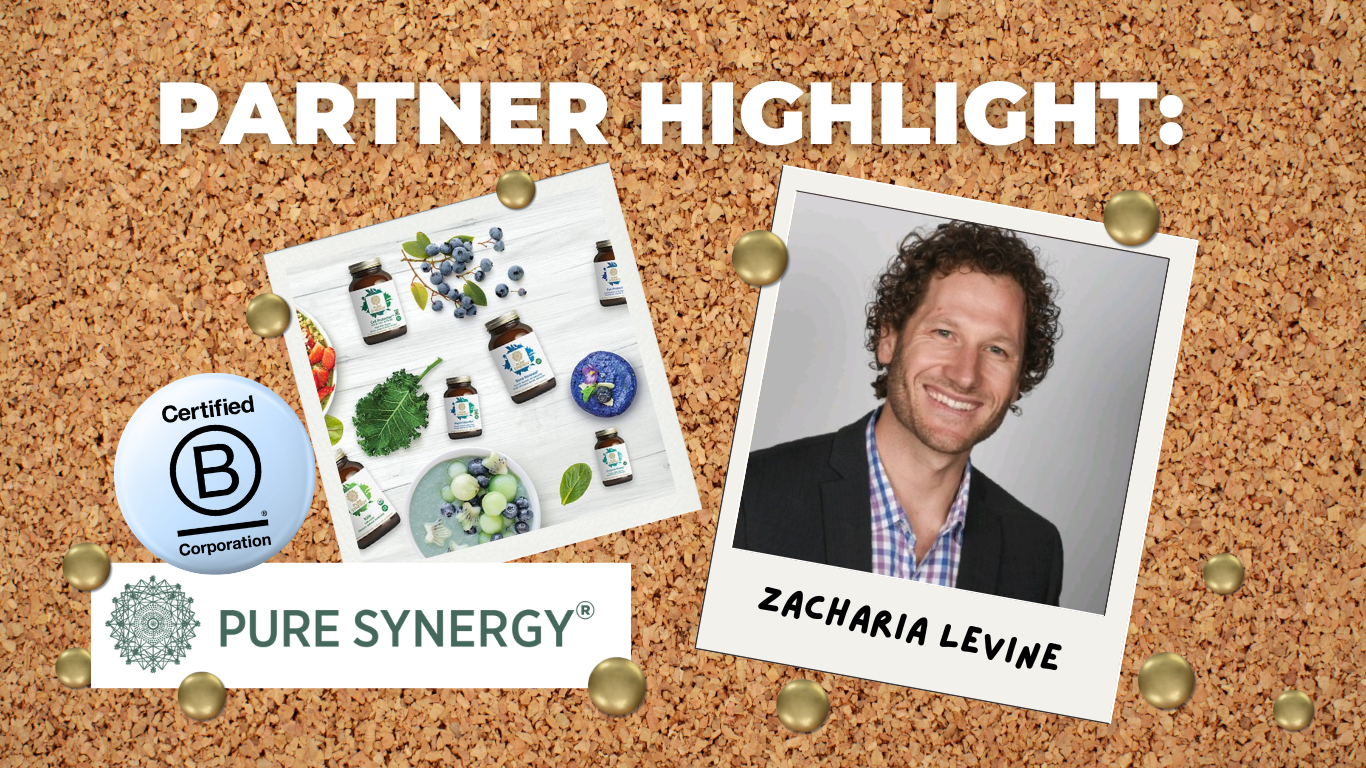
To understand how those principles show up inside the company today, we spoke with Zacharia Levine, Head of Organizational Stewardship. Before joining Synergy, Zacharia spent years working in community and economic development, including serving as Director of Community and Economic Development for Grand County. His background in systems thinking, resilience planning, and gateway-community dynamics has profoundly informed his approach to business leadership, stewardship, and sustainability at Synergy.
What follows is a wide-ranging conversation about purpose, independence, employee ownership, and why climate-aligned insurance has become a natural extension of Synergy’s mission.
Premiums for the Planet: You came to Synergy from community and economic development. What led you to make that transition into the private sector?
Zacharia Levine: In Moab, The Synergy Company always stood out. It was a light manufacturer and wellness company thriving in a place with few adjacent industries, and that sparked my curiosity. I wanted to understand its origin story, how it sustained itself, and what it could teach us about resilience in gateway communities.
Over time, I came to see Synergy not just as a business but as a model for values-driven growth. My path has always been about working at the intersection of values and impact, and Synergy was already living the principles I believed in. Joining the company felt like a natural evolution and a chance to work from the inside out on systems-level change.
PFP: Synergy has remained independent for more than thirty years. In an industry dominated by investor-backed brands, how has that shaped the company’s identity?
ZL: Our founders, Mitchell and Jayne May, built Synergy to be a people-first, community-oriented business. They turned down acquisition offers and resisted pressure to relocate because independence preserves our integrity.
Independence means we can prioritize long-term relationships, product purity, and ethical sourcing instead of short-term gains. It lets us make decisions that reflect our mission rather than market trends. Over time, that has become a strategic advantage that strengthens trust with customers, partners, and our team.
PFP: Mitchell May helped shape the National Organic Program. How does that legacy influence Synergy’s approach to sourcing, innovation, and growth?
ZL: Mitchell has always believed that how we source matters as much as what we produce. His commitment to organic ingredients goes back to witnessing the health impacts of pesticide exposure on farm workers in Los Angeles. That experience shaped a higher standard long before the market demanded it.
Innovation at Synergy is driven by Mitchell’s curiosity, what we affectionately call ‘bog crawling,’ which is a search for rare, potent ingredients rooted in healing traditions and backed by peer-reviewed science.
His work on the National Organic Program reminds us that if something important does not exist, we may have a responsibility to help create it. That ethos influences everything from our ingredient philosophy to our renewable energy commitments. For example, we were a founding member of Rocky Mountain Power’s renewable energy program, helping make Moab the first EPA Green Powered Community. For more than twenty years, we have offset over one hundred percent of our electricity usage with wind and solar.
PFP: You’ve been exploring employee ownership models. Why is ownership such an important issue for mission-led companies like Synergy?
ZL: Ownership is a sustainability issue. When founders exit, many purpose-driven companies are sold to investors who dilute or discard the mission. Mission-lock across generations of ownership is critical if we want integrity to endure.
Shared ownership is also about recognizing that the people who help build the company should have a stake in its success. We are asking what it could look like to extend ownership or profit sharing to values-aligned suppliers as well. In a company where integrity is non-negotiable, this shift could be transformative.
Our current owners have mandated that we think at least two generations into the future when making high-stakes decisions. That kind of long-term lens is rare, and it is essential.
PFP: What does sustainable growth look like inside Synergy on a day-to-day basis?
ZL: Responsible growth forces you to account for impacts that many businesses treat as externalities. Triple bottom-line wins are wonderful, but they are not always easy to find.
My role is to ensure purpose and sustainability are embedded across the organization. Whether it is Procurement co-designing mutually beneficial contracts, Warehouse applying lean principles to reduce material waste, Maintenance identifying equipment upgrades that lower electricity usage, or Marketing being deeply careful in how we tell the story of our ingredients, every team is empowered to ask how we can do something better, more responsibly, and with greater integrity.
We do not grow for growth’s sake. We ask why we should grow, for whom, and at what cost. Those questions help us challenge the assumptions behind the ‘grow at any cost’ model.
PFP: Synergy is a certified B Corp. What did that process reveal about the company and its commitments?
ZL: Synergy was founded on the belief that integrity and environmental responsibility are compatible with good business. When we first incorporated, much of the language we now associate with responsible business did not exist.
B Corp certification gave us a structured way to assess how well we were living up to our values. Some findings were not what we hoped, and closing those gaps was motivating.
We improved our B Impact Assessment score by nineteen percent, which affirmed our progress. But certification is not a finish line for us. It is a floor, not a ceiling. The drive to improve is embedded in our culture.
PFP: You’ve said purpose can be a profit center. How does that show up across your operations and partnerships?
ZL: Consumers want more than a product. They want to trust the company behind it. In our industry, where people ingest what we make, the stakes are even higher. When someone truly feels the difference with Synergy, we build a long-term relationship grounded in wellness and shared values.
Embedding purpose is also a risk-mitigation strategy. It increases preparedness and resilience. It shows up everywhere: in how we work with suppliers, how our Customer Experience team builds connection, and how Finance balances generous benefits with long-term sustainability.
My advice to other leaders is simple. Embed purpose into daily decisions and behaviors. When it is real and operational, it drives loyalty, strengthens your business, and creates a culture people want to be part of.
PFP: Synergy was one of the earliest supporters of Premiums for the Planet. What about PFP’s work resonated with you?
ZL: A presentation on financed emissions opened my eyes to the climate impacts of banking. When I later came across a post from Brad Stevenson, the parallels between banking and insurance clicked.
What really moved me was the idea that in the business world, what does not get insured does not come to fruition. Every financial decision is an opportunity to reinforce our purpose. PFP offered a new lens for aligning our spend with our values.
Insurance is a significant business expense. Anywhere purpose-driven companies can turn an expense into a positive impact is a win. PFP helped us make the invisible visible and showed us that climate-aligned insurance is a mindset shift.
PFP: You live and work in Moab. When you think about the long-term health of this region, what gives you hope about the role businesses can play?
ZL: Moab is contested terrain. It is under pressure from resource extraction, development, and visitation, and living here is a daily reminder of what is at stake.
The red rock canyons, the night skies, the soulful sojourns, and the rowdy adventures with family and friends inspire awe and responsibility. What gives me hope is seeing businesses embrace that responsibility not just as a duty but as a privilege.
If we stay rooted in place and purpose, I believe we can help keep places like Moab vital for generations to come.